So picture this: you are a young engineering student who just came out of a difficult class like intro to circuit theory. You know that most of the circuits that you analyzed were far too simple to do for anything too complicated. You also know that because engineers are lazy, they must have another way of doing complicated analysis of electrical systems. Enter the impulse response. There is a really interesting property for Linear-Time-Invariant (LTI) Systems where if you input an impulse (i.e. the Dirac delta function) into a black box system, then the response tells you everything that you need to know. This is AMAZING for analysis, because you don't need to know the specifics of the system, you only need to know a single function.There are some practical limits to this, like it's impossible to actually make a true impulse (both on the impulse side, and the probability that things might blow up), but we can get really really close. It's also possible to extract the impulse response other ways than experimentally, but that's besides the point. The point is that the impulse response of a system tells you everything that you need to know about how an input signal turns into an output signal. The final part is the actual process of how we combine any old arbitrary input signal and the impulse response, and the answer is: convolve them together.
Maybe you remember convolution from your integral calculus class, but if you're like me, then you don't remember much of anything other than the basics from Calc 2. Convolution, denoted as $f(t)*g(t)$, is defined as
$$\begin{align}
\int_{-\infty}^{\infty} f(\tau)g(\tau - t) d\tau
\end{align}$$
t is time (here it is, but that's not true in general). Quickly it's important to note a few of the useful properties that are associated with convolution.
- Associative
- Commutative
- Distributive
- The Shift Property
The shift property is simply that if $f(t)*g(t)=c(t)$ then $f(t-T_1) * g(t-T_2) = c(t-T_1 -T_2)$. If you've ever tried to do math without those properties then I don't know why you're reading this, but you'll also know just how essential those few properties are to basic math.
Now, to the fun part of this. If you have some system like a bandpass filter that is useful for communications. The filter is too complicated to solve for by circuit analysis, because ultimately you only care that it behaves like a frequency dependent function. If the input is in the right frequency, it gets strengthened. If the input is the wrong frequency it gets attenuated. So you find a filter that somebody has already designed and find the formula for the impulse response that is probably based around certain parameters (like the center frequency of our bandpass filter). Next you want to do some analysis to make sure it's correct.
So I'm not here to show you how to actually perform convolution, because honestly, it's the worst. We can look here at some examples though of what is actually happening as something is convolved. So consider $f(x)$ is a sinc function and $g(x)$ is a rectangular window function. The way to think of convolution is that one function remains static, just as you'd expect (usually the complicated function). The second function is going to be flipped across the y-axis. You then take that function and slide it across the other function. At each point you multiple the two together (the red portion that appears in the gif), the output of the convolution then is the blue line in the second graph, which is the integral of the red portion above.
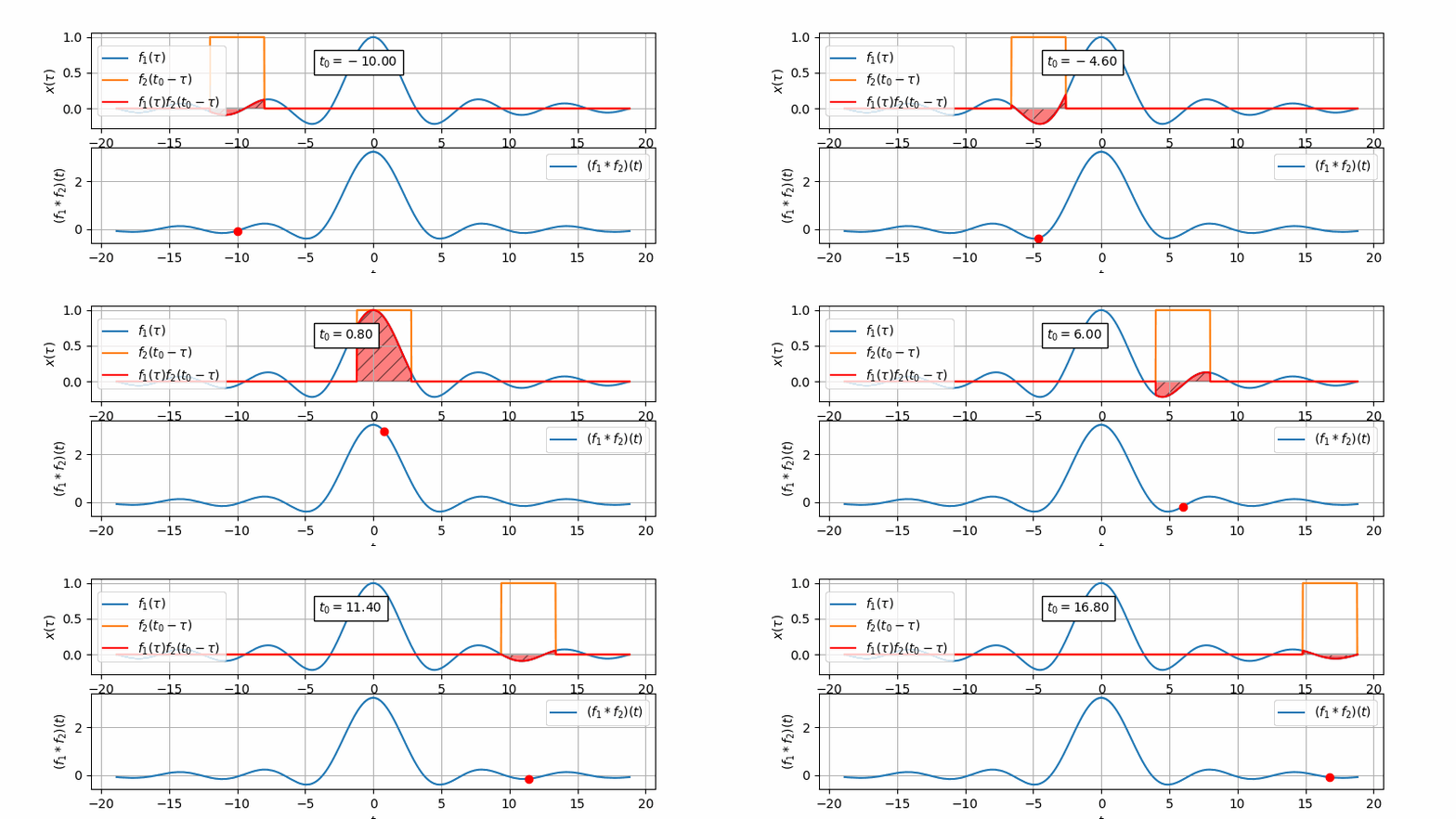
For your viewing pleasure, I've made a bunch, because I can. I'm going to be modifying hopefully so that they look nicer, but for now they're perfect.
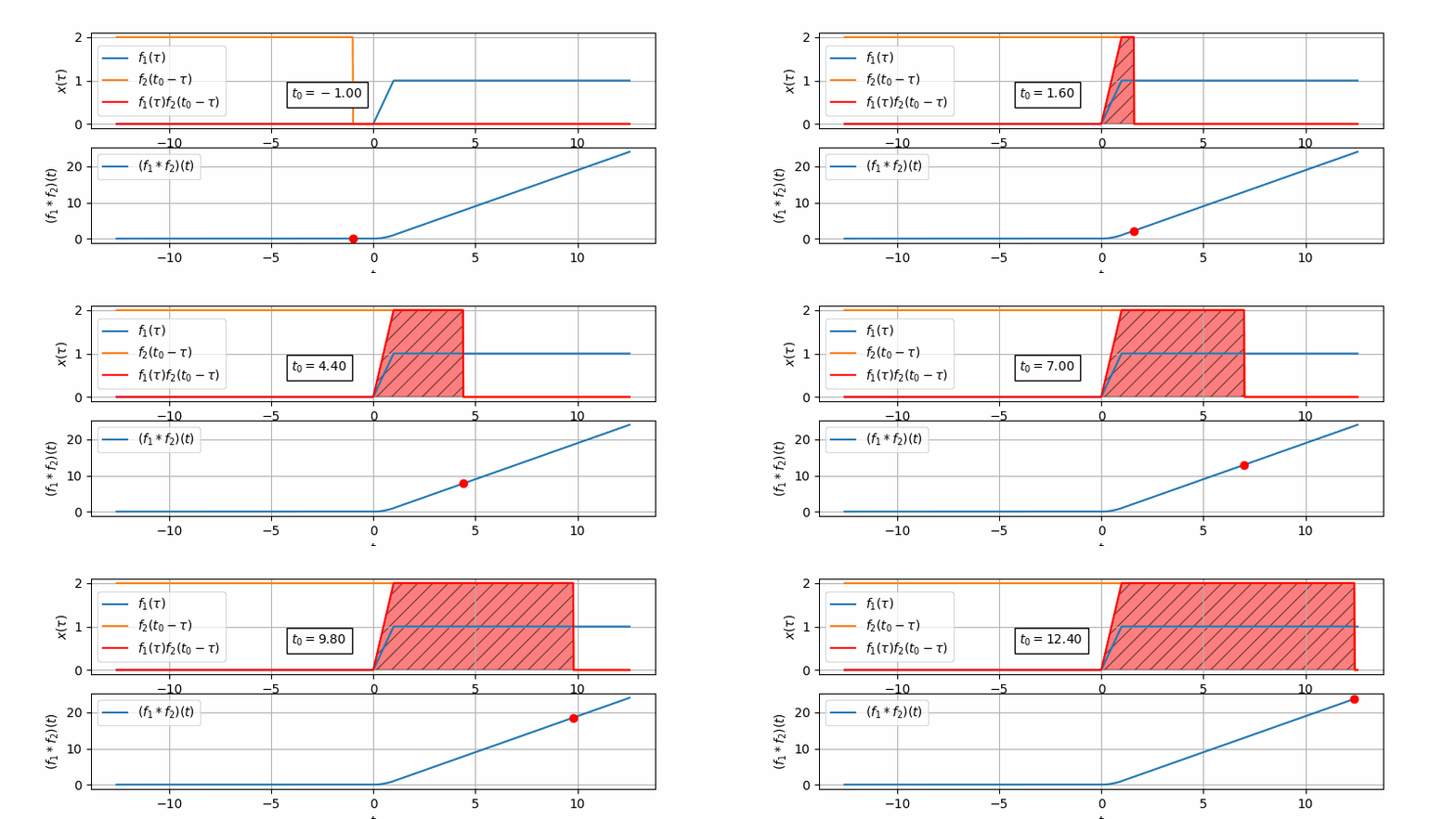
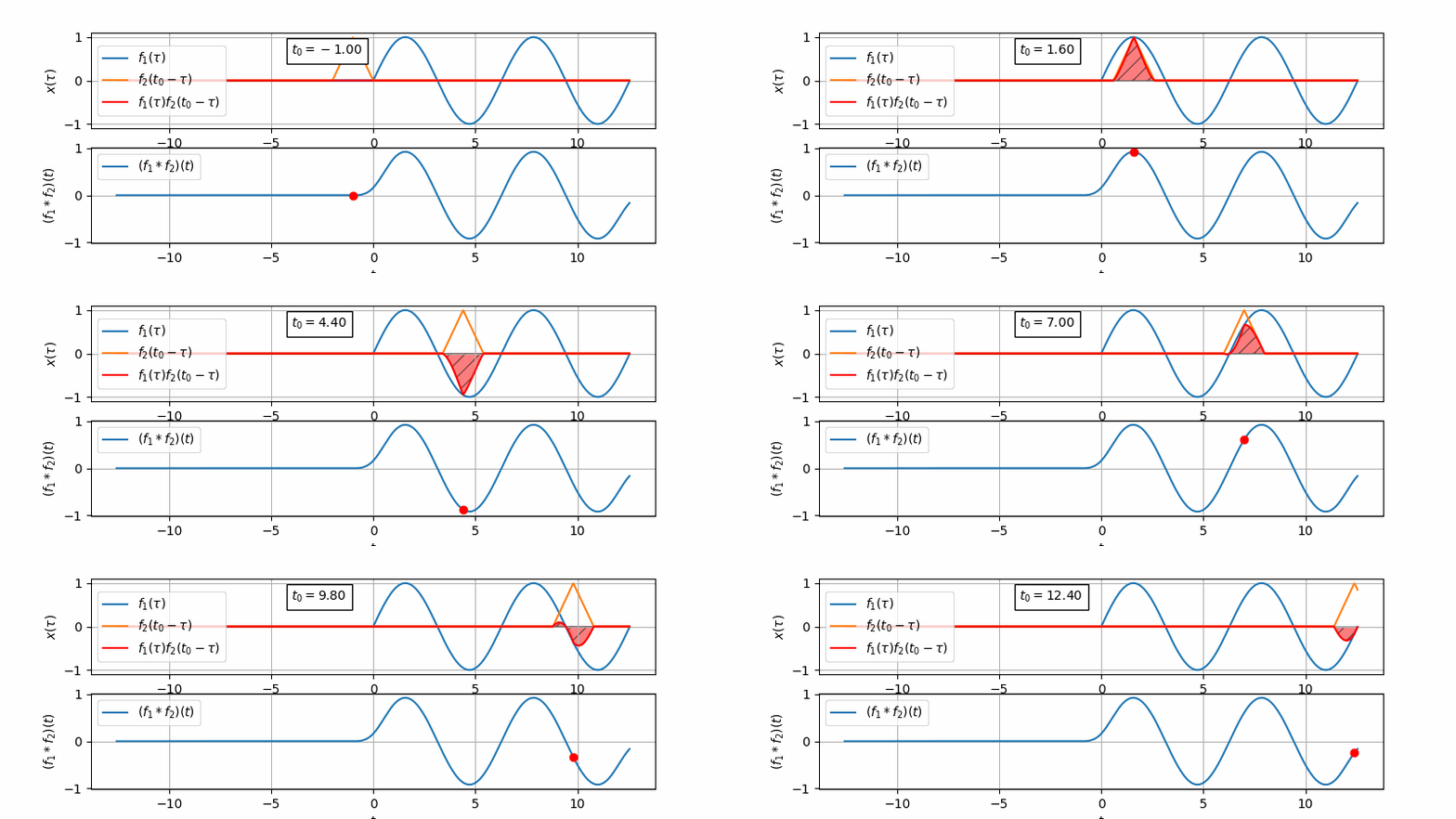
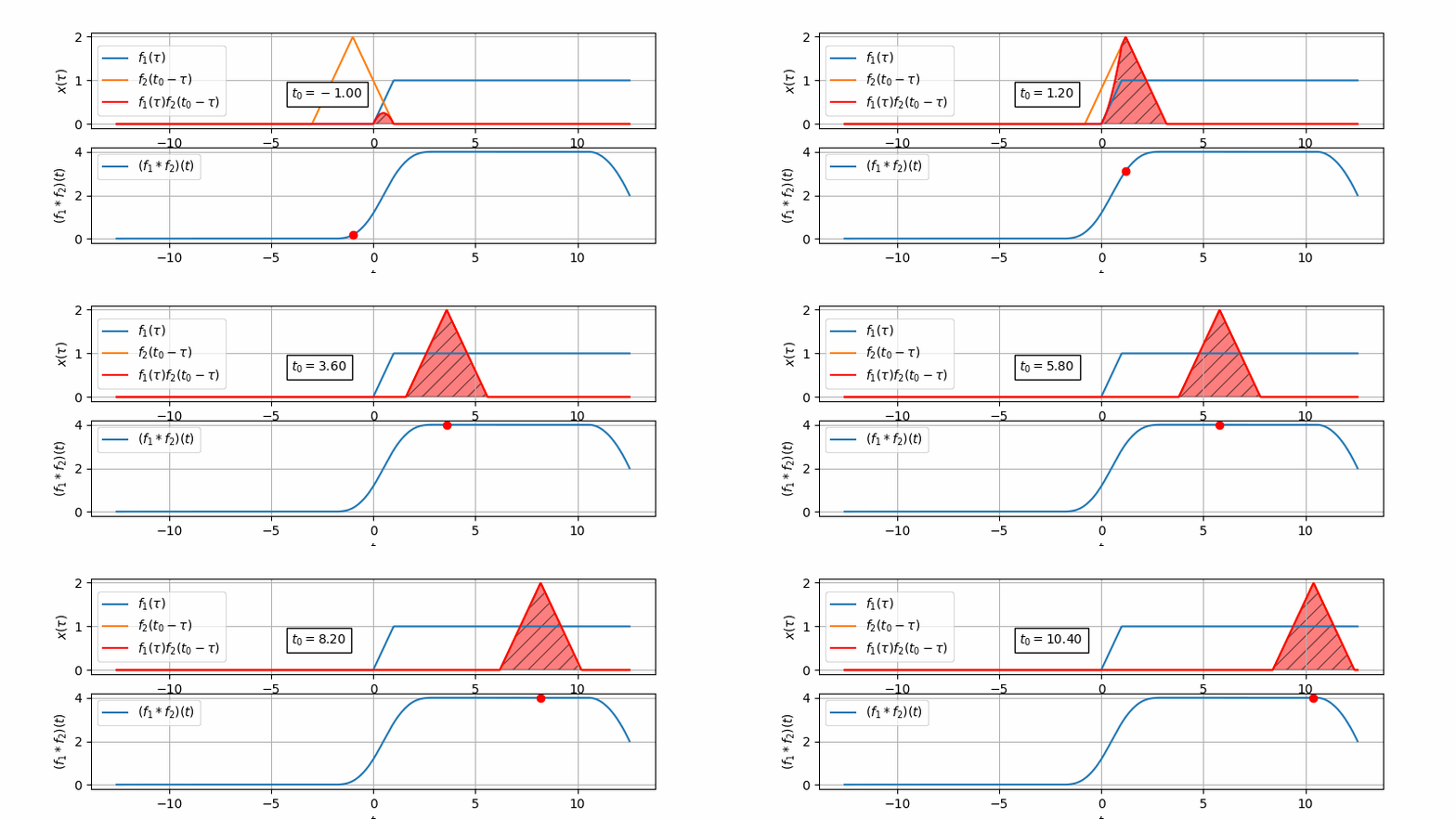
If you're interested in generating more animations like this one, look at this github repo: https://github.com/jdanielharman/Convolution-Animator.
Additionally, you can look at the Stack Exchange question from which I modified the code: https://stackoverflow.com/questions/56095788/convolution-integral-export-as-animation