The first place to start with any new subject is to define terms.
Okay, so we now know that we're dealing with inputs and outputs. We'll think of the signal as the input, that will lead to something more useful that we'll consider as the output. So why do we even care? Let's consider WiFi to answer this question. Even 3.2 $\mu$ seconds, your phone or laptop is taking a voltage reading off of its on-board antenna. This information by itself is useless. It's filled with noise and probably a lot of different interfering information. Although, when considered with the others readings, this single data point tells a greater story. By processing the long stream of information, or the signal, the systems in your phone can extract the useful information amide the greater noise. That is probably how you are reading this right now, which is pretty cool.
Next, we need some way to measure this signal. For electro-magnetic waves voltage is a natural choice, but so would current or power.
So what do we put as the y-axis or the dependent variable? Well, energy seems a good place to start. This measure is called
by the source below. So what happens if you have a periodic, constant-amplitude, signal, like most every useful signal? It doesn't really
make sense to consider a non-converging limit as a measure for the signal. In situations like this, we consider the
as a useful measure of the signal. So there are some weird exceptions to these two measures. The first is the ramp function, $x(t)=t$, approaches infinity. As it's not periodic, there is not periodic average, nor does it converge to a finite energy, so neither measure works. The second is the unit step function, which isn't periodic, but it still has a finite power, because it has a constant amplitude.
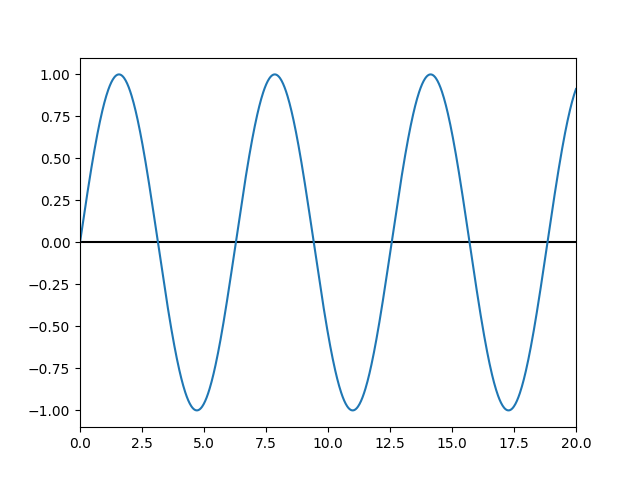
Fig 1. An example of a periodic signal
Imma add some useful things you can do to signals, but later. I'm tired.